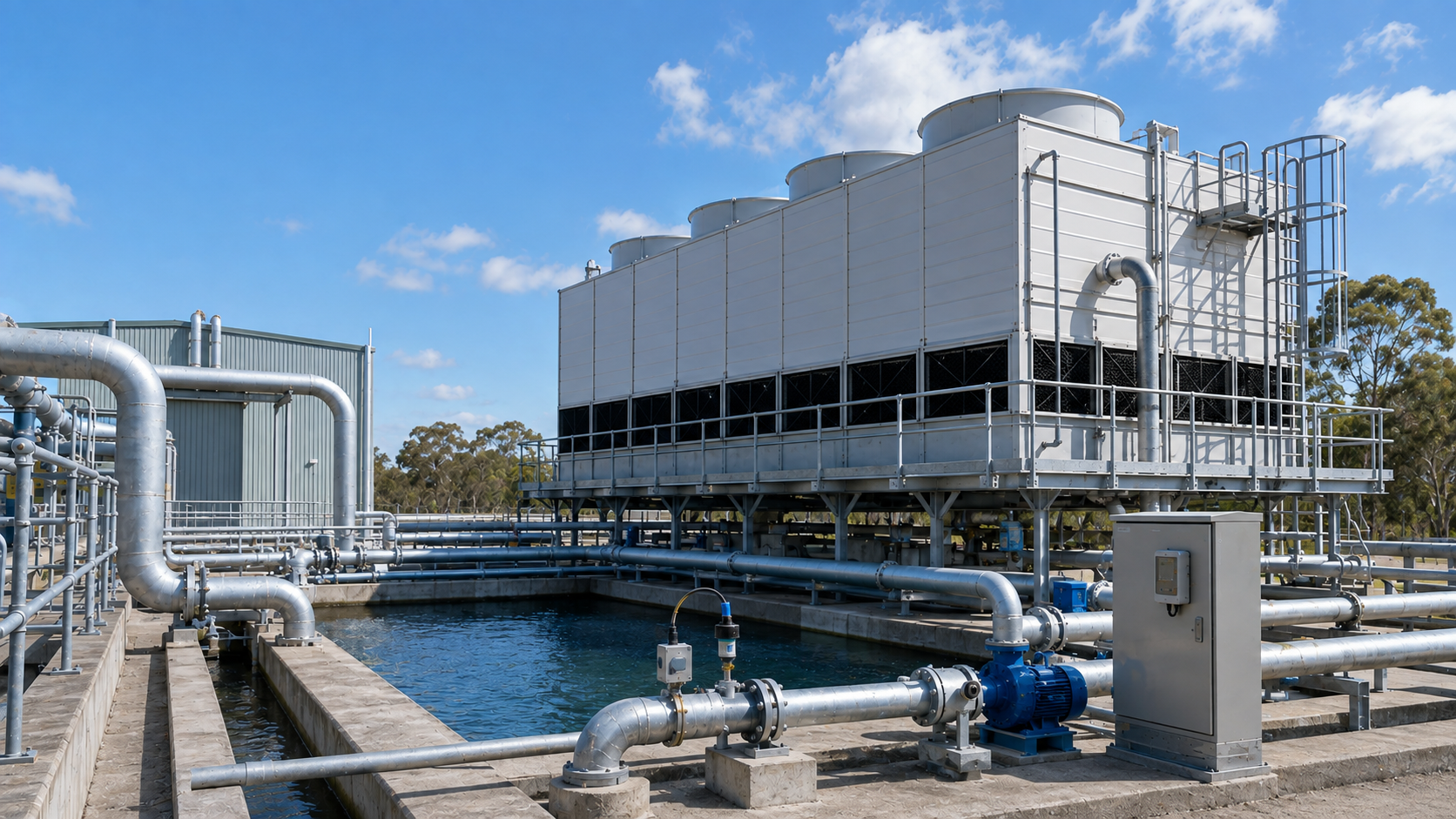
The job of a cooling tower is to remove heat from your building or industrial process. As water circulates, some of it evaporates and carries heat away. It is an effective process, but the minerals in that water do not evaporate with it.
Over time, those minerals become more concentrated. Add airborne dust, organic matter and changing water conditions, and the water can begin working against the system instead of helping it.
A well-managed chemical water treatment program helps control these conditions, supporting better performance, lower operating demands and a longer equipment life.
What happens when cooling tower water is left untreated?
Cooling tower water is constantly changing. Water evaporates, fresh make-up water enters the tower, and contaminants are drawn in through the airflow.
Without suitable monitoring and treatment, three things can happen:
- Scale
- Corrosion
- Microbiological growth
These issues affect the tower in different ways, but they can also feed into one another. Corroded surfaces collect debris, while scale and sediment create places for biofilm to grow.
Water may still be circulating, but that doesn’t mean the system is cooling efficiently.
Scale reduces heat transfer
Scale forms when concentrated minerals settle on fill media, spray nozzles, pipework and heat-transfer surfaces. Even a thin layer can act as insulation, making it harder for heat to leave the system. Blocked nozzles and coated fill can also disrupt water distribution, leaving some parts of the tower to work harder than others. The result – reduced cooling capacity and greater demand on pumps, fans, chillers and connected HVAC equipment.
Chemical treatment can help control scale-forming minerals. Conductivity monitoring and correctly managed bleed or blowdown are also important because they prevent dissolved solids from becoming too concentrated.
Corrosion can shorten equipment life
Cooling towers contain metal components that are regularly exposed to water, oxygen and changing operating conditions. If the water chemistry is not controlled, those components can begin to corrode.
Corrosion can affect basins, pipework, support structures and mechanical equipment. What starts as surface deterioration can eventually lead to leaks, weakened components or an unexpected shutdown.
A suitable treatment program includes corrosion inhibitors and pH control to reduce these risks. The correct approach depends on the system materials, make-up water quality and operating conditions.
There is no universal dose for every cooling tower. More chemical is not necessarily better; accurate dosing and regular testing are what matter.
Microbiological growth is more than just cleanliness
Warm, recirculating water can support bacteria, algae and other microorganisms when conditions are not controlled.
These organisms can form biofilm on wet surfaces, restricting water flow, blocking spray nozzles and reducing heat transfer across the fill. Biofilm can also protect bacteria from disinfectants, making the system more difficult to bring back under control.
Microbiological treatment may include oxidising or non-oxidising biocides, routine testing and scheduled cleaning as part of a broader water management program.
Poorly managed cooling water systems can also run the risk of being affected by Legionella bacteria growth, spreading through fine airborne droplets. Chemical treatment alone doesn’t remove this risk. Effective control relies on treatment, inspection, cleaning, monitoring and appropriate system management working together.
What should a water treatment program include?
Effective treatment should be designed around the cooling tower and its operating environment. Water quality, temperature, system materials, operating load and cycles of concentration can all influence exactly what is required.
A typical program may include:
- Regular pH and conductivity testing
- Monitoring chemical and disinfectant residuals
- Scale and corrosion inhibitors
- Oxidising or non-oxidising biocides
- Controlled bleed or blowdown
- Microbiological sampling where required
- Basin cleaning and sediment removal
- Accurate treatment and service records
The program should set clear control limits and explain what action to take when results fall outside them. Individual test results matter, but trends can provide a clearer picture of how the water is changing over time.
Why chemical treatment and mechanical maintenance belong together
Water treatment cannot correct damaged fill, blocked nozzles, poor airflow, a leaking basin or a failing pump. In the same way, replacing mechanical components without resolving poor water quality may allow scale, corrosion or biofilm to return. The best results come from treating the cooling tower as one connected system.
At Cooling Tower Solutions, every cooling tower service begins with an inspection of the tower and its key operating components. Then we’ll provide a condition report outlining the health of the system, required maintenance and practical recommendations.
Depending on the tower, this can include checking:
- Spray headers, nozzles and water distribution
- Fill media and drift eliminators
- Air intakes and louvers
- Make-up water float valves
- Cold water basins
- Structural supports
- Fans, motors, gearboxes and drive systems
If we find deterioration, our team can provide preventative maintenance, emergency repairs, corrosion rectification, replacement parts and system optimisation. We also supply genuine Brentwood fill media and drift eliminators where replacement is required.
Cooling Tower maintenance in Queensland conditions
Cooling towers operating in Queensland face high temperatures, humidity, strong UV exposure and demanding seasonal loads. These conditions make regular inspection and maintenance especially important.
Based in Yatala, Cooling Tower Solutions services Brisbane, the Gold Coast and surrounding regions. We offer quarterly preventative maintenance, annual servicing and customised programs based on site conditions, operational requirements and budget.
Chemical treatment is not just about adding products to water. It is about maintaining the right balance, monitoring how the system responds and supporting it with practical mechanical care.
Contact Cooling Tower Solutions to discuss a maintenance and repair program that helps improve performance and extend the life of your cooling tower.