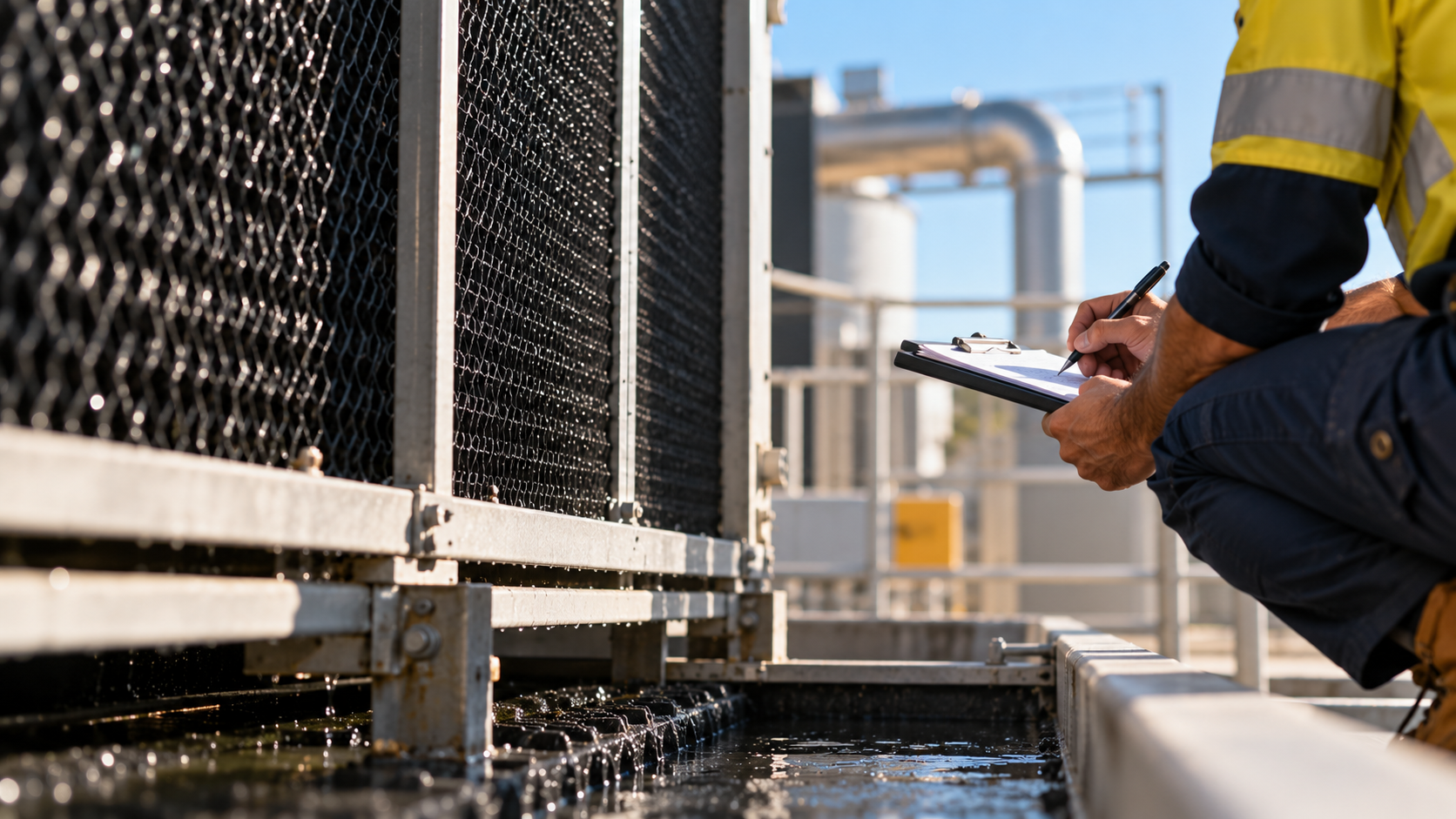
There’s a difference between a cooling tower that’s just running and one that’s running well. Some of the most expensive HVAC issues we see don’t often start with a breakdown. They often start quietly.
A nozzle begins to block.
Water distribution becomes uneven.
Fill starts accumulating scale.
A fan develops vibration.
Corrosion spreads across a section that looked relatively minor six months ago.
When things are still running, maintenance can go on the back burner. But, in reality, the system is becoming less efficient, components are working harder, and a straightforward maintenance job can slowly turn into a much bigger repair. This is the real cost of delaying commercial HVAC maintenance.
The expensive part can happen before anything breaks
When a cooling tower isn’t performing efficiently, the HVAC system often just compensates. If heat rejection becomes less effective, the system has to work harder to achieve the required cooling. This leads to longer operating periods, higher energy consumption and additional load across connected equipment.
When you’re operating in a large commercial building, any efficiency loss matters.
Australian Government guidance estimates HVAC can account for around 50% of a building’s total electricity consumption and approximately 70% of base-building electricity consumption, although this varies significantly between buildings. It also identifies preventative maintenance as an important part of maintaining HVAC energy efficiency. (Australian Government – HVAC Best Practice Guide)
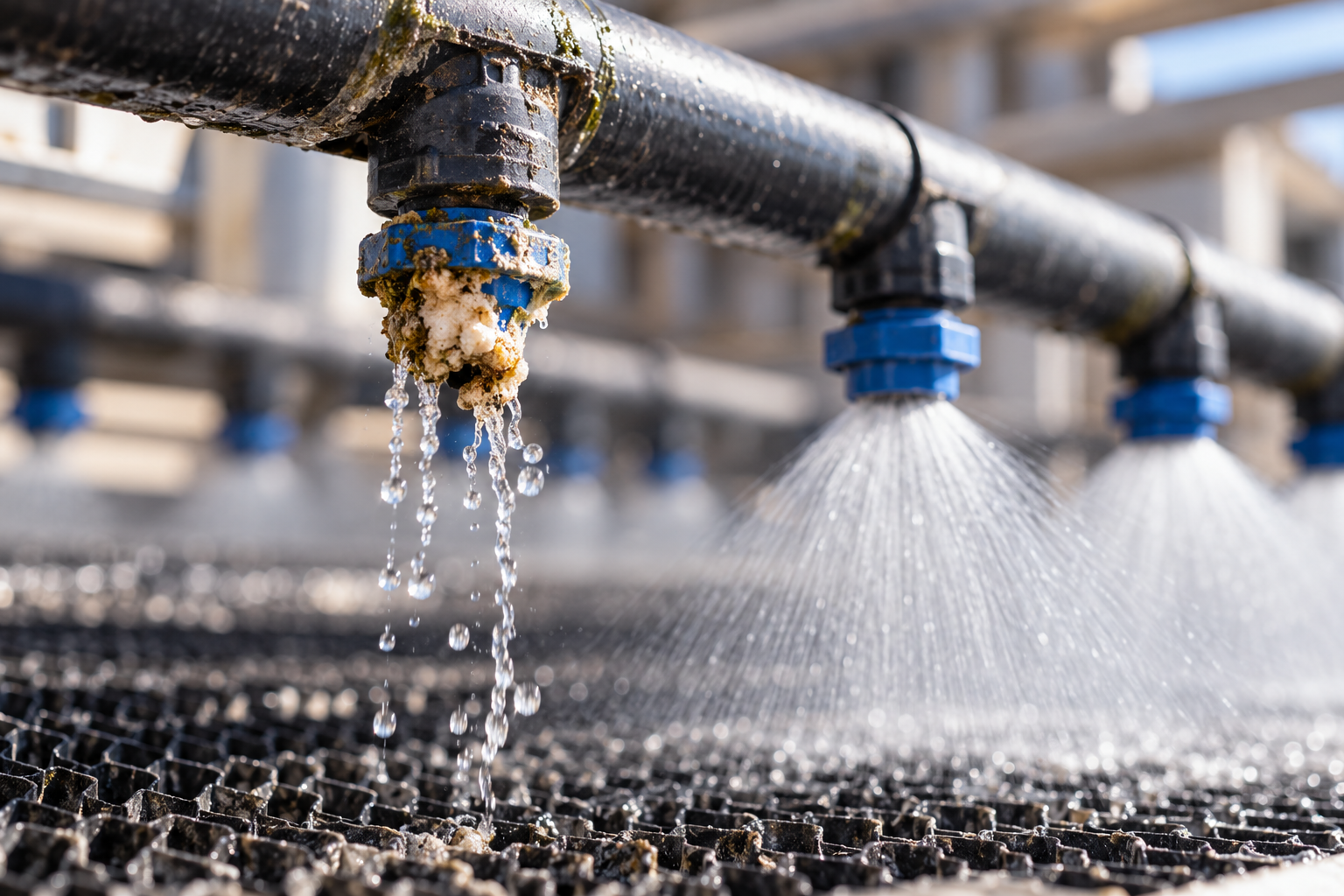
A blocked nozzle isn’t just a blocked nozzle
This is where cooling tower maintenance and servicing are important. Components don’t operate in isolation.
For example, let’s look at the water distribution system. If spray nozzles become partially blocked, water may no longer be distributed evenly across the fill. Sections of fill can become under-utilised, reducing the effective heat-transfer area of the tower.
It may not necessarily be a catastrophic failure in itself, but together, it can change how the tower performs. The $500 problem becomes the $5,000 problem
Preventative cooling tower maintenance isn’t about replacing everything at the first sign of wear. Good maintenance is about understanding what condition the equipment is actually in, what can continue operating safely and what needs attention before it affects something else.
Emergency repairs are never convenient
One of the biggest advantages of preventative maintenance is having control over when the work happens. When an issue is picked up early, parts can be sourced, contractors scheduled, and site access organised. If equipment needs to be taken offline, the work can often be planned around quieter operating periods or coordinated with other maintenance.
An unexpected failure gives you none of that flexibility.
If a critical cooling tower component fails during operation, suddenly you’re dealing with urgent parts, emergency labour and potentially after-hours work, while trying to minimise disruptions. Depending on your facility, reduced cooling capacity can affect far more than building comfort. It can interrupt industrial processes, compromise temperature-sensitive areas or equipment, and create problems for tenants and facility operations.
This is where the true cost of reactive maintenance becomes obvious. The replacement component might be relatively straightforward; it’s the urgency, downtime and disruption surrounding the repair that can make an unexpected failure considerably more expensive.
Maintenance is an efficiency issue
With cooling towers, energy efficiency and maintenance go hand-in-hand. The condition of fill, water distribution, airflow, heat-transfer surfaces and mechanical equipment all influence how effectively heat can be rejected.
That means the maintenance conversation shouldn’t only be: “Is the equipment still working?” It should also be: “How hard is the system working to do the same job?” Facility managers should be looking at whole-of-life operating costs.
What should be checked during cooling tower maintenance?
A proper cooling tower inspection and service should look beyond the obvious mechanical components.
Fans, motors, gearboxes and drive systems matter, but so do water distribution systems, spray headers and nozzles, fill media, drift eliminators, air intake louvres, make-up water controls, cold water basins and the tower’s supporting structure.
You’re looking for changes: corrosion that has progressed, unusual vibration, blocked distribution points, damaged fill, leaks, deterioration and anything else that could affect performance or reliability.
The condition report that comes out of that inspection is extremely valuable because it gives the site a basis for planning.
How long can commercial HVAC maintenance be delayed?
There’s no one answer to this question. A cooling tower running long hours through a Queensland summer has different demands from equipment operating intermittently under lighter loads. Tower age, water quality, environment, equipment condition and manufacturer requirements all influence the appropriate servicing schedule.
Instead, ask whether you actually know the condition of the equipment you’re choosing to keep running. If the last inspection identified corrosion, deteriorating fill, mechanical wear or water-distribution problems, extending the maintenance interval isn’t simply postponing an invoice. You’re accepting the risk that the condition will continue to deteriorate.
Don’t wait until the tower decides for you
There are two ways to maintain cooling towers. You can inspect the equipment, understand its condition and plan the work. Or you can wait until something forces the issue.
At Cooling Tower Solutions, we provide cooling tower repairs, servicing and preventative maintenance for commercial and industrial facilities across Brisbane, the Gold Coast and surrounding areas. We inspect the complete tower, provide clear condition reporting and help sites prioritise maintenance based on what actually needs attention.
If it’s been a while since your cooling tower was properly inspected, contact Cooling Tower Solutions to arrange an inspection or discuss a preventative maintenance program for your site.